
There are journeys you take for adventure, and then there are journeys that call to your soul. Among the snow-capped peaks of Western Tibet lies a mountain that defies modern geology and modern logic alike. Mount Kailash is not merely a landmark; it is a Yantra—a cosmic diagram made flesh, a mandala of rock and ice that billions believe to be the spiritual center of the universe.
As we look toward the 2026 pilgrimage season, the air is thick with anticipation. According to the Tibetan lunar calendar, 2026 is the Year of the Fire Horse, a once-in-12-years cosmic alignment that supercharges the spiritual merit of the Kailash Kora.
If you have ever dreamed of standing before the abode of Lord Shiva, walking in the footsteps of Milarepa, or simply testing your limits against the highest passes on earth, this is the year to answer that call.
Here is everything you need to know about the Mount Kailash Yantra, the sacred Kailash Yatra, and the power of the Kailash Kora in the auspicious year 2026.
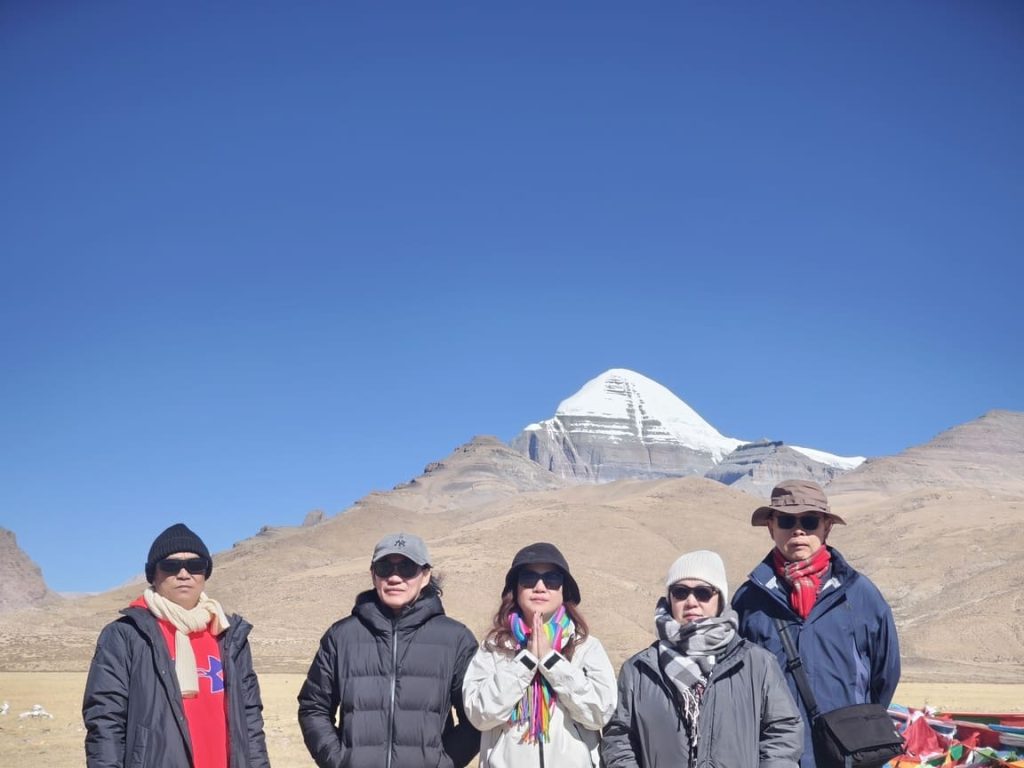
The Yantra – Understanding the Mountain as a Mandala
In the Vedic and Tantric traditions, a Yantra is a geometric design that acts as a receptacle for divine energy. It is a tool for meditation, a cosmic blueprint. Mount Kailash is often described as the ultimate natural Yantra.
The Four Faces of the Divine
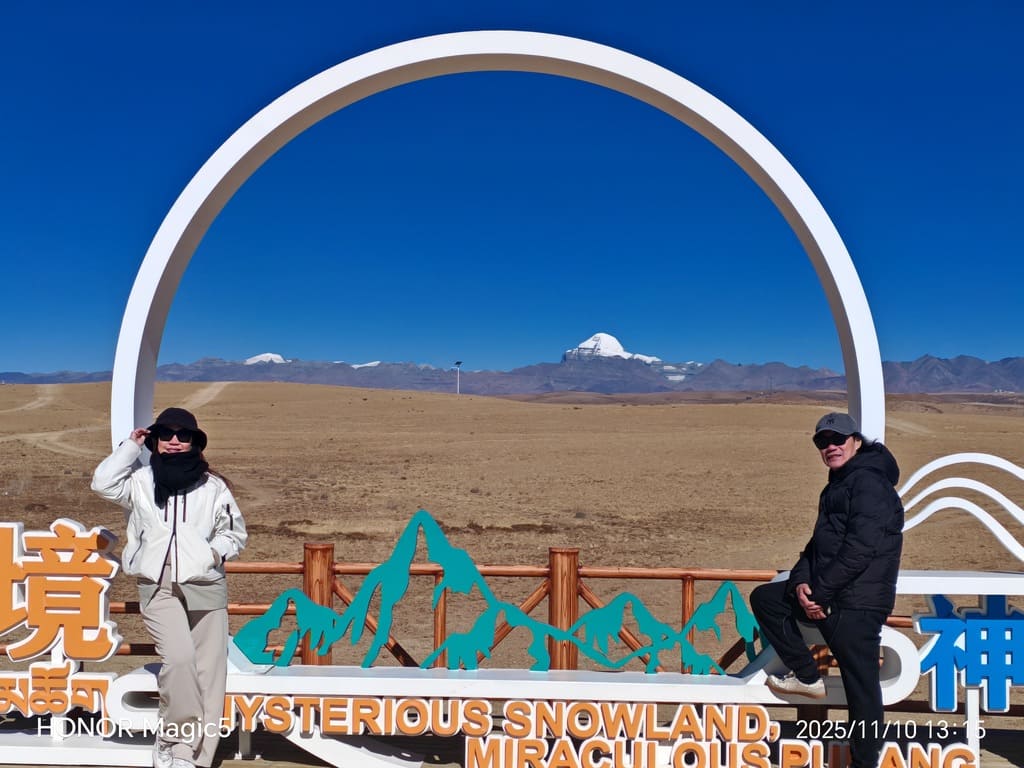
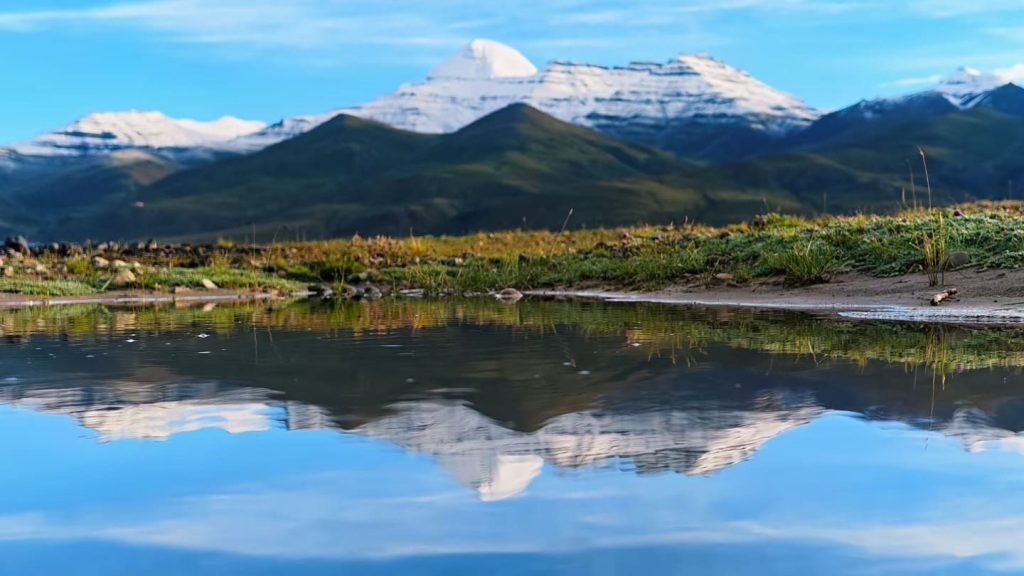
Geologists remain puzzled by Kailash. Unlike the jagged, rugged peaks of the Himalayas (like Everest), Kailash is a perfectly symmetrical pyramid. Its four sheer faces align almost perfectly with the four cardinal directions.
- The South Face: A deep vertical cut with a horizontal line across the center. To Hindus, this is the Swastika—the symbol of well-being—and is revered as the face of Lord Shiva.
- The West Face: Often associated with the Buddhist aspect of Demchok (Chakrasamvara), representing ultimate bliss.
- The North & East Faces: Reflect the golden hues of the rising and setting sun, representing the preservation and creation aspects of the cosmic cycle.
When you look at the mountain, you aren’t just looking at a peak; you are looking at a three-dimensional, 6,638-meter-high Yantra that has been projecting “OM” vibrations into the Tibetan plateau for millennia. The Kailash Yantra is believed to be the Stambha (pillar) of the world, the axis Meri (Axis Mundi) around which our material reality revolves.
Why the “Yantra” Activates in 2026
In Tibetan Buddhism and Hindu astrology, the energy of a Yantra is not static; it fluctuates with time. The Year of the Horse (specifically the Fire Horse) represents energy, speed, and loyalty. In the context of Kailash, the “Wind Horse” (Lungta) carries prayers from earth to heaven.
In 2026, the geomantic alignment is considered perfect. The “wind” energy is at its peak, meaning that intentions set during the Kailash Yatra are believed to manifest with lightning speed. It is said that doing the Kailash Kora in this specific year is the equivalent of doing 13 (or in some traditions, 12) koras in a normal year.
The 2026 Kailash Yatra – Practical & Spiritual Logistics
The Kailash Yatra is not a vacation; it is an expedition into the roof of the world. In 2026, while the spiritual energy is high, the logistics are changing.
1. The New Permit Regulations (Crucial for 2026)
As of the 2026 season, the Chinese/Tibetan authorities have updated the rules for the Kailash Mansarovar Yatra.
- The Waiting Game: Visa processing (Group Visas) now requires a physical presence in Kathmandu for a minimum of 5 to 6 working days. It is no longer a quick in-and-out.
- The Group Rule: Independent travel is strictly forbidden. Foreign pilgrims (including NRIs) must travel in organized groups of at least 5 people booked through a licensed operator.
- The Timeline: You need to submit your documents to your tour operator at least 45 to 60 days in advance to secure the Tibet Travel Permit (TTP) and the Military Border Pass for Ngari.
2. Choosing Your Route
There are three main ways to approach the Yantra, depending on your budget, age, and fitness level.
A. The Overland Classic (via Kyirong/Kerung)
- Best for: Purists and budget-conscious pilgrims.
- The Experience: You drive from Kathmandu to the Tibetan border. The gradual ascent over 3-4 days offers the best acclimatization, which is vital for surviving the high pass.
B. The Helicopter Express (via Simikot/Hilsa)
- Best for: Seniors and those with severe time constraints.
- The Experience: You fly from Nepalgunj to Simikot, then by helicopter to Hilsa. Warning: This route saves time but drastically increases the risk of Acute Mountain Sickness (AMS) because you jump from low altitude to 4,000m+ rapidly.
C. The Indian Government Route (Lipulekh/Nathu La)
- Best for: Indian passport holders.
- The Experience: Managed by the MEA and ITBP. It is highly subsidized but also highly competitive and physically demanding due to the rugged walking trails.
3. The Full Moon Factor
If you want to maximize the “Yantra” effect, plan your Yatra to coincide with a Full Moon (Purnima).
- June 2026: (Peak Season) – The moon reflecting off Lake Mansarovar is described as “celestial milk.”
- July 2026: (Guru Purnima – July 28) – Considered the holiest full moon of the year for the Guru-Shishya tradition.
Note: Full moon batches sell out 4-5 months in advance. Do not delay booking if you want these dates.
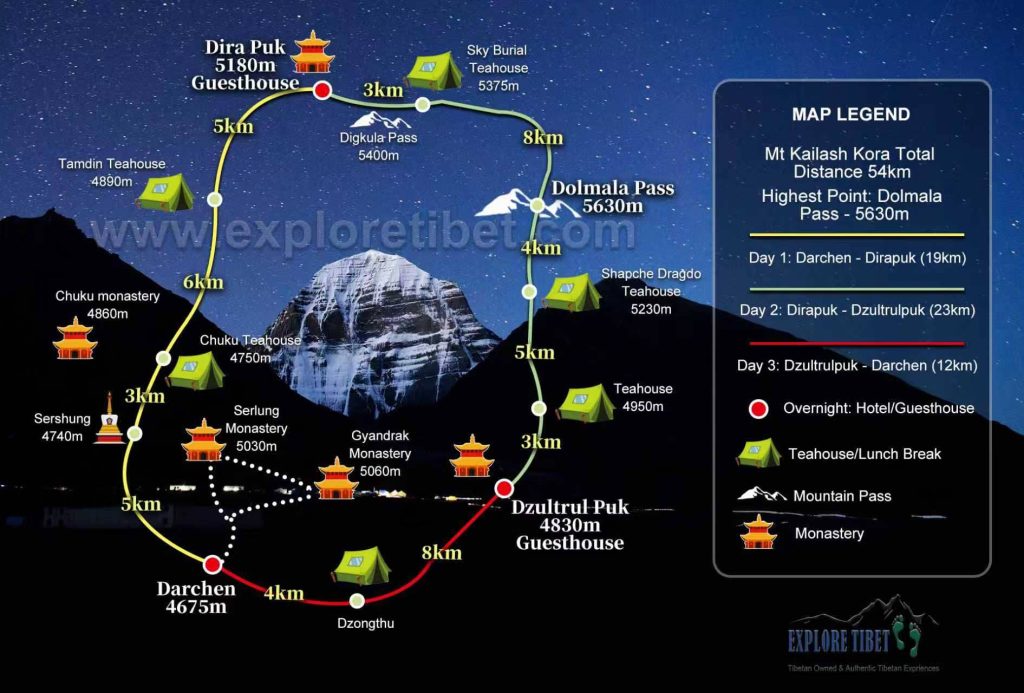
The Kailash Kora – The 52km Walk to Enlightenment
The heart of the pilgrimage is the Kailash Kora (Parikrama). It is a 52-kilometer (32-mile) trek that circles the base of the Mount Kailash Yantra. For Tibetan Buddhists and Hindus, the physical act of walking clockwise around the mountain is a powerful ritual that cleanses the ego and accumulates merit.
Here is what your 3 days on the Kora will look like in 2026.
Day 1: The Threshold (Yamadwar to Dirapuk)
- Distance: ~10km / 6 hours
- Altitude: 4,600m to 4,920m
You begin at Yamadwar (The “Gate of Death”), symbolically leaving your mortal life behind. The trail winds through the “Valley of God,” a stark, beautiful desert flanked by prayer flags. After a few hours, the North Face of Mount Kailash explodes into view. You spend the night at Dirapuk Monastery, sleeping directly under the sheer black rock face of the Yantra. It is an overwhelming, often tearful sight.
Day 2: The Crucible (Dirapuk to Zuthulpuk via Dolma La)
- Distance: ~22km / 9-10 hours
- Altitude: 4,920m to 5,636m (Dolma La) down to 4,790m.
This is the day you “die” and are “reborn.” You wake up at 3:00 AM to start the ascent. The climb to Dolma La Pass is steep, the oxygen is 50% of sea level, and the wind is fierce. At the top (5,636m), pilgrims leave behind old clothes, locks of hair, or photographs—symbolically shedding their sins and old identities.
Just below the pass lies Gauri Kund (the Lake of Compassion), often frozen, its waters considered the tears of the divine feminine. The descent is brutally long on the knees, but you eventually reach Zuthulpuk (the Miracle Cave), where the great yogi Milarepa is said to have performed miracles.
Day 3: The Integration (Zuthulpuk to Darchen)
- Distance: ~14km / 3-4 hours
A gentle, celebratory walk out of the valley. The wind horse flags wave you back to civilization. You have completed the Kailash Kora. You are not the same person who started three days ago.
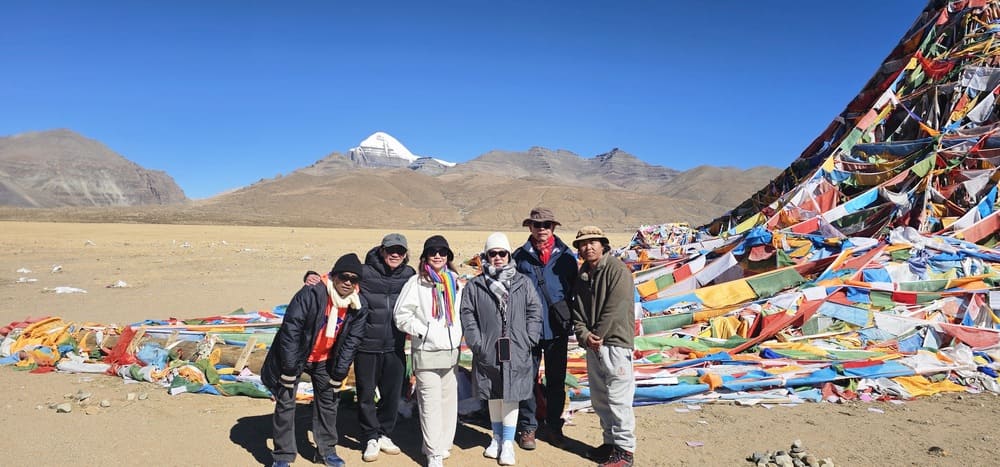
Deeper Mythological Stories – The Legends That Power the Yantra
To walk the Kailash Kora without knowing its mythology is like reading a book with half the pages missing. The mountain is a living library of miracles. Here are two essential stories that every pilgrim should carry in their heart.
The Legend of Milarepa vs. Naro Bönchung
In the 11th century, the great Buddhist yogi Milarepa sought to establish Buddhism’s supremacy at Mount Kailash. He was challenged by Naro Bönchung, a master of the indigenous Bön religion. The contest was simple: whoever could reach the summit of Kailash first by sunrise would claim the mountain for their tradition.
Naro Bönchung climbed rapidly on a magical drum. Milarepa, however, sat in meditation at the base, seemingly doing nothing. As dawn broke, Naro Bönchung was nearing the top. In that instant, Milarepa flew through the air on the rays of the rising sun, landing at the summit just before his rival. Naro Bönchung conceded defeat but asked for one favor: a place where the Bönpo could still practice.
Milarepa granted him a small valley on the southeastern face of the mountain. Today, as you walk the Kailash Kora, you will see the Tarboche Flagpole—the starting point of the pilgrimage—which commemorates this very contest. The lesson is not about winning, but about the power of inner stillness over outer effort.
The Creation of Lake Mansarovar and Rakshas Tal
Long ago, when the cosmic mind of Brahma conceived the universe, he visualized a perfect reservoir of pure consciousness. That vision became Lake Mansarovar—the highest freshwater lake on earth. Hindus believe that the lake was formed from the pure thoughts of Brahma himself. Its waters are said to bestow liberation simply by touching them.
Nearby lies Rakshas Tal (The Lake of the Demon). Unlike the circular, serene Mansarovar, Rakshas Tal is irregular, salty, and devoid of aquatic life. Legend says it was created by the demon king Ravana as a site for his intense austerities to please Lord Shiva, who resides on Kailash. While Mansarovar represents the Sun (masculine, pure, life-giving), Rakshas Tal represents the Moon (feminine, mysterious, deathly). Pilgrims bathe in Mansarovar before the Kora but avoid the waters of Rakshas Tal. The two lakes, separated by a thin strip of land, represent the eternal dance of opposites—good and evil, pure and impure—that defines human existence.
Daily Spiritual Practices on the Kailash Kora
Walking the Kora is not just a physical trek; it is a moving meditation. In 2026, consider integrating these practices into each day of your pilgrimage.
Morning Ritual: Prostrations at Yamadwar
Before you take your first step, perform three full prostrations facing the mountain. Silently state your intention. For Tibetan Buddhists, this is a vow to complete the circuit. For Hindus, it is an act of surrender to Shiva. For seekers of any faith, it is a moment to ask: Why am I here?
Midday Practice: Mantra Walking
The simplest and most powerful practice is to synchronize your breath with a mantra. As you walk, repeat “Om Namah Shivaya” (for Hindus) or “Om Mani Padme Hum” (for Buddhists) with every fourth step. In the Fire Horse year of 2026, the Lungta (wind energy) is said to carry these mantras directly to the celestial realm without delay.
The Prayer Flag Ritual
At the highest point of Dolma La Pass, you will find thousands of prayer flags—blue for sky, white for air, red for fire, green for water, yellow for earth. In 2026, bring a fresh set of flags inscribed with the names of your loved ones. Tie them to the existing lines while visualizing your prayers flying on the wind. Do not take old flags down; let them disintegrate naturally, releasing their blessings over months.
The Three Circumambulations of Dirapuk
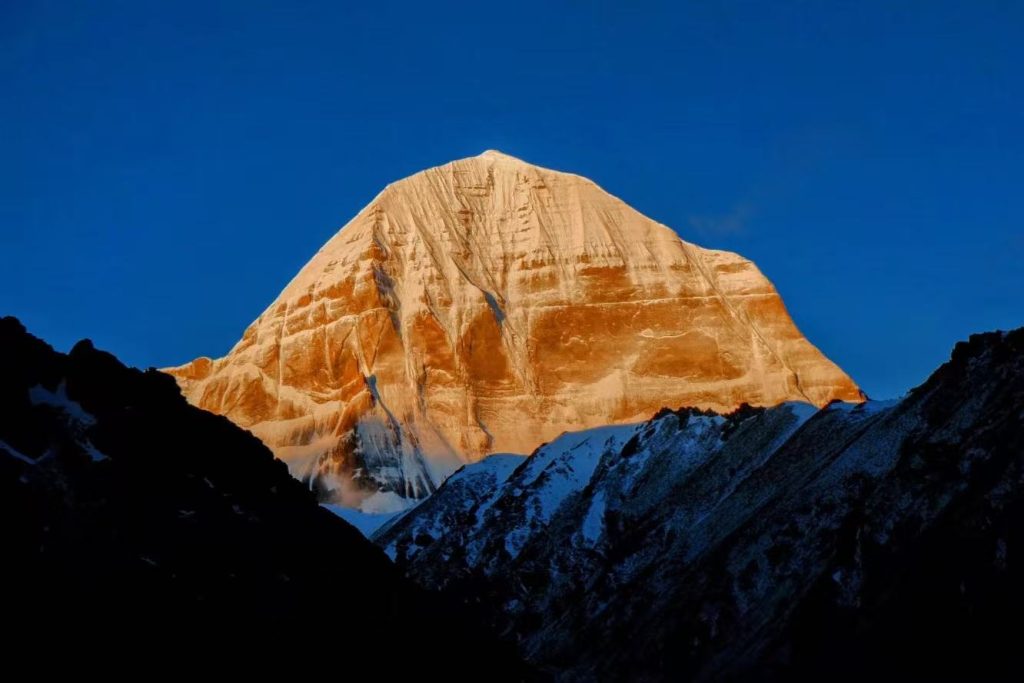
At Dirapuk Monastery on Day 1, many pilgrims perform three small circumambulations (koras) around the monastery before sunrise. This is believed to “charge” the body before the main Kora. The north face of the Mount Kailash Yantra glows a deep copper color at dawn during the 2026 spring season—a sight photographers and mystics alike describe as otherworldly.
Evening Reflection: The Gratitude Stone
Each evening after walking, pick up a small stone from the trail. Hold it in your palm. Reflect on one hardship you overcame that day. Then, before sleeping, place the stone outside your tent or guesthouse window as an offering to the mountain guardians.
The Kailash Yatra is often called the “Trek of Death” by expedition doctors—not to frighten, but to emphasize the seriousness of the altitude. In 2026, with the Horse Year crowds, rescue resources may be stretched. Your preparation is your responsibility.
A 6-Month Training Plan
Months 5-6 (Aerobic Base):
- Walk 5-7 km daily with a 3-5 kg backpack.
- Add stair climbing (20-30 floors, 3 times weekly).
- Swimming or cycling for low-impact lung capacity.
Months 3-4 (Altitude Simulation):
- Train with a hypoxic mask (if available) or perform high-intensity interval training (HIIT) to spike your VO2 max.
- Hike on weekends with 8-10 kg packs on steep inclines.
Months 1-2 (Peak Conditioning):
- Back-to-back long walks: 15 km on Saturday, 10 km on Sunday.
- Practice walking at night with a headlamp (to simulate the 3 AM Dolma La ascent).
- Taper rest 10 days before departure.
Essential Packing List for 2026 (Updated)
- Clothing: Merino wool base layers (top and bottom), fleece mid-layer, down jacket (rated to -20°C/-4°F), waterproof/windproof shell pants and jacket, thermal socks (4 pairs), insulated waterproof boots (broken in).
- Gear: Trekking poles (two, with spare rubber tips), headlamp (200+ lumens with extra batteries), 1-liter wide-mouth water bottle (does not freeze as easily as narrow mouths), insulated hydration sleeve, sleeping bag rated to -15°C (5°F) or lower.
- Medicine: Diamox (Acetazolamide for AMS prevention—consult your doctor), Dexamethasone (emergency AMS treatment), basic first aid, blister patches, electrolyte powder, diarrhea medication.
- Spiritual Items: Small prayer flag set (new for 2026), a photo or token to leave at Dolma La, a journal, a small bell or singing bowl (if weight permits).
Acclimatization: The Non-Negotiable Rule
Do not fly directly into Lhasa (3,650m) and then drive to Darchen (4,600m) without rest days. The classic route via Kyirong includes a mandatory acclimatization stop at Saga (4,280m). In 2026, spend two nights there, not one. Drink 5-6 liters of water daily. Avoid alcohol completely until after the Kora. Sleep in a sitting position (or with head elevated) to reduce nighttime hypoxia.
Month-by-Month 2026 Seasonal Weather Guide
Choosing the right month for your Kailash Yatra can mean the difference between clear skies and blizzard conditions.
| Month | Avg. Day Temp | Night Temp | Trail Conditions | Crowd Level | 2026 Special Note |
|---|---|---|---|---|---|
| May | 5°C (41°F) | -8°C (18°F) | Snow possible on Dolma La; lower trails dry | Low to Medium | Best for solitude. Spring flowers at Mansarovar. |
| June | 12°C (54°F) | -2°C (28°F) | Ideal; snow melting; streams high | High | The summer solstice (June 21) offers the longest daylight for the Kora. |
| July | 15°C (59°F) | 2°C (36°F) | Optimal; green valley views | Very High | Guru Purnima (July 28) – most spiritually potent. |
| August | 14°C (57°F) | 1°C (34°F) | Monsoon clouds; occasional rain | Very High | Good for photography (dramatic clouds). |
| September | 10°C (50°F) | -3°C (27°F) | Clear, crisp air; no rain | Medium | Post-monsoon clarity – best mountain views. |
| October | 4°C (39°F) | -10°C (14°F) | Snow risk after mid-October | Low | Last chance before winter closure. |
Recommendation for 2026: Go in late May or early September to balance crowd avoidance with clear weather. If you seek the spiritual peak of the Fire Horse year, book the last week of July (Guru Purnima).
The Vision – The Future of the Sacred Landscape
As 2026 approaches, the Tibetan authorities have announced restorations of historical pilgrimage routes (like Lipulekh) and the implementation of a Digital Management System to protect the fragile ecosystem of Mount Kailash Yantra.
The Shift to Sustainable Pilgrimage
In 2026, there is a heavy push for “Leave No Trace” principles. The days of littering the Kora path are over; authorities are enforcing strict ecological laws. When you visit in 2026, you are not just a pilgrim; you are a steward of this sacred geometry.
What does this mean practically?
- You will be asked to carry a small reusable bag for your own waste.
- Single-use plastics (water bottles, chip wrappers) are banned on the Kora trail. Bring a reusable bottle; boiled water is available at tea houses.
- Human waste management: Use designated toilet tents at campsites. Do not dig cat holes near water sources.
The Fire Horse Prophecy
Tibetan elders whisper that a Fire Horse year at Kailash is a time of “rapid awakening.” It is said that those who complete the Kailash Kora in 2026 will experience a karmic acceleration—meaning that spiritual realizations that might take lifetimes can occur in a single circuit. Skeptics may call this superstition, but countless returned pilgrims report strange synchronicities, vivid dreams, and life-altering clarity after walking the Kora in previous Horse years (2002, 2014).
The Final Word
Why go in 2026?
Because the Horse Year is a multiplier of faith. Because the bureaucracy, the altitude sickness, and the cold are temporary, but the sight of Kailash at sunrise is eternal. Whether you call it Kang Rinpoche, the Yantra of Shiva, or simply the roof of the world, Mount Kailash in 2026 is waiting.
You will stand at Yamadwar, the Gate of Death, and you will realize that the only thing you truly leave behind is your smaller self. You will climb Dolma La at 3 AM under a blanket of stars, and for one frozen, gasping moment at 5,636 meters, you will understand why humans have been walking this circle for thousands of years.
Not to conquer the mountain. But to be conquered by it.
Om Namah Shivaya.
Ready to answer the call?
Check with authorized local operators for the 2026 Kailash Yatra packages. Secure your permits early, train your lungs, and prepare your heart for the highest pilgrimage on earth. Contact us at [email protected]
Frequently Asked Questions (2026 Updates)
Q: Is the 2026 Kailash Yatra harder than other years?
A: The route is the same, but the expectation of merit is higher. Physically, the cold and altitude remain the primary challenges. However, due to high demand in the Horse Year, the trails may be crowded, requiring more patience.
Q: Can I bathe in Lake Mansarovar in 2026?
A: As of 2025/2026 regulations, direct dipping into the lake is prohibited to preserve the ecosystem. However, pilgrims can collect water in a bucket to bathe on the banks.
Q: What if I cannot walk the full Kailash Kora?
A: In 2026, helicopter “darshan” options are expanding, and you can hire horses or local porters to carry you across the pass. However, you must book these services in Darchen in advance.
Q: Do I need to be religious to benefit from the Kailash Yantra?
A: Not at all. The mountain’s power is described as “non-denominational.” Atheists and agnostics who have completed the Kora often report a profound sense of peace and a perspective shift. The Yantra works on the geometry of your own mind, regardless of belief.
Q: What is the single most important item to pack?
A: Beyond the obvious (warm clothes, Diamox), experienced pilgrims say it is earplugs. Shared guesthouses are loud with snoring, coughing, and wind. A good night’s sleep at altitude is priceless.