+86-15889090408
[email protected]

Tucked away in the breathtaking mountains of Tibet, Ganden Monastery stands as one of the most significant and revered centers of Tibetan Buddhism. With its rich history, stunning architecture, and spiritual resonance, Ganden continues to attract thousands of pilgrims, tourists, and scholars alike. Known for its deep connection to the Gelug school of Tibetan Buddhism, Ganden has long been a beacon of Buddhist philosophy, practice, and culture. In this blog post, we’ll delve into the history, significance, restoration, and experience of visiting this sacred site.
Ganden Monastery, located around 40 kilometers (25 miles) from Lhasa, Tibet’s capital, was founded in 1409 by Je Tsongkhapa, the revered Tibetan Buddhist scholar and teacher. Tsongkhapa is best known for founding the Gelug school of Tibetan Buddhism, which emphasized monastic discipline, rigorous study, and the importance of analytical meditation.
The founding of Ganden Monastery was a milestone in the development of Tibetan Buddhism. Tsongkhapa envisioned it as a center for advanced Buddhist studies, meditation, and monasticism. Its construction was backed by Tsongkhapa’s disciples and patrons, many of whom were aristocrats and influential figures in Tibetan society.
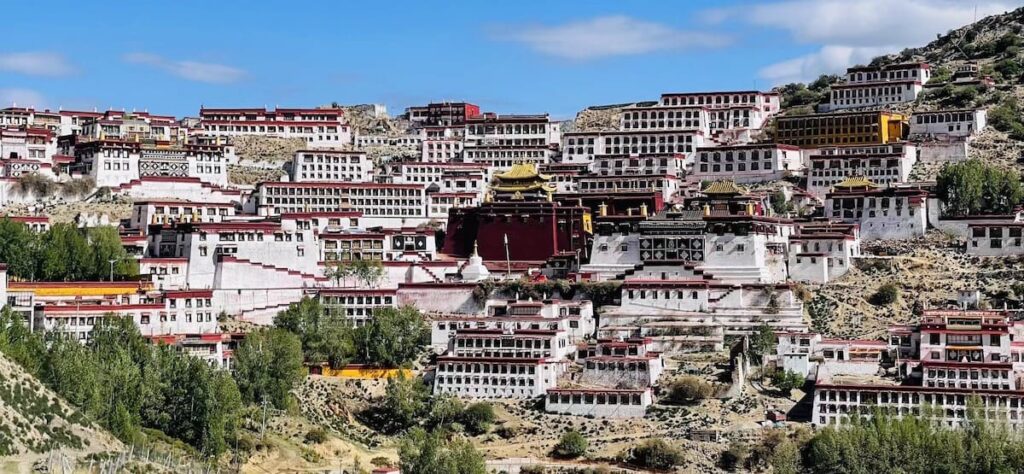
The name “Ganden” means “Pure Land” in Tibetan, which symbolizes the ultimate aim of Buddhist practice — attaining enlightenment and a pure state of mind. The monastery’s foundation stone was laid on Mount Ganden, an area that was chosen due to its proximity to the sacred Potala Palace, the seat of the Dalai Lama in Lhasa, making it a natural spiritual hub for Buddhist practitioners.
Ganden Monastery holds a central place in the Gelug tradition, often referred to as the “Yellow Hat” school due to the color of the monks’ robes. The Gelug school became the dominant school of Tibetan Buddhism, particularly after the rise of the Dalai Lama institution in the 17th century.
The monastery is famous for its scholarly importance. For centuries, it served as an educational center, with monks engaging in rigorous academic studies of Buddhist philosophy, logic, and ethics. Ganden is also notable for its role as a major pilgrimage site. Pilgrims come to Ganden Monastery to pay homage to the sacred remains of Je Tsongkhapa and to take part in the religious rituals that continue to define the monastic life here.
Ganden Monastery also holds spiritual significance as it is regarded as one of the three great Gelug monasteries, alongside Sera and Drepung. These three monasteries are considered the heart of the Gelug school, with each playing a vital role in the dissemination of Buddhist teachings and the training of monks.
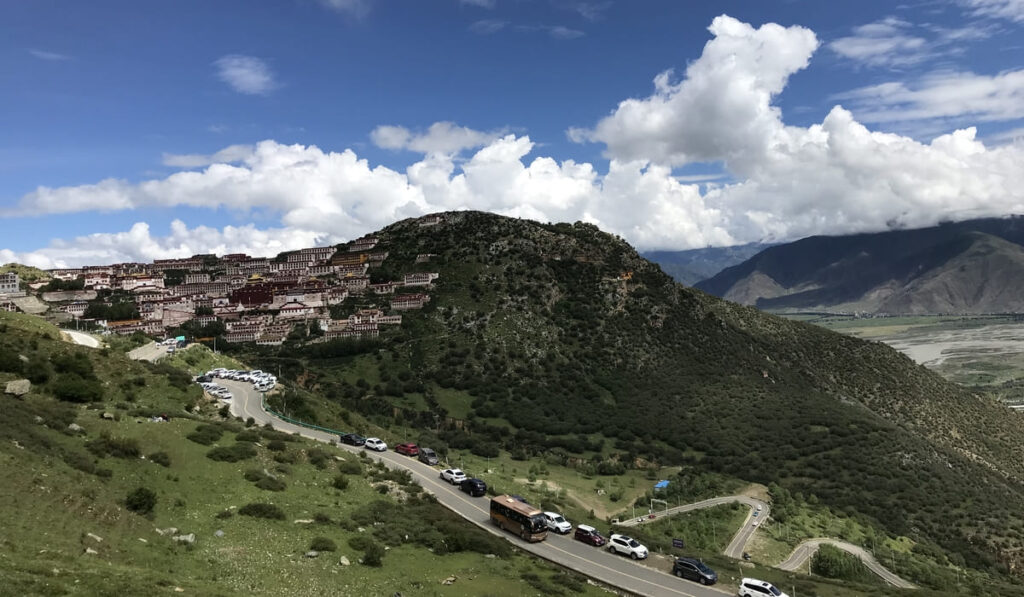
The architecture of Ganden Monastery reflects the grandeur and beauty of Tibetan Buddhist art and design. The monastery complex is built in a traditional Tibetan style, with a mix of intricate woodwork, ornate murals, and golden statues. Its structures are divided into several sections, each serving a specific religious or functional purpose.
At the heart of the monastery lies the Ganden Lhakhang (Main Temple), where a large statue of Je Tsongkhapa is enshrined. This temple is considered the spiritual center of the monastery. The hall is adorned with beautiful murals and thangka paintings that depict scenes from the life of Tsongkhapa, as well as various Buddhist deities and historical figures. The Ganden Lhakhang is not only a place of worship but also a repository of sacred Buddhist texts and relics.
One of the most iconic architectural features of Ganden Monastery is its position atop a hill. The monastery is built on Mount Ganden, which offers panoramic views of the surrounding valleys and mountains. The landscape itself plays a significant role in the monastery’s spiritual ambiance, creating a serene environment conducive to meditation and prayer. Pilgrims visiting Ganden often walk the Kora (pilgrimage circuit) around the monastery, a ritual that is believed to accumulate merit and purify the mind.
Beyond the main temple, there are various smaller shrines and chapels scattered throughout the monastery complex. These sites are dedicated to different Buddhist deities, and each has its own unique symbolism and significance in Tibetan Buddhist cosmology.
Despite facing challenges, particularly during the Chinese Cultural Revolution, Ganden Monastery remains a thriving center of Tibetan Buddhist practice. It has undergone extensive restoration in recent decades, with efforts to rebuild its structures and revive its monastic traditions.
The monastery is home to hundreds of monks who engage in daily rituals, prayer sessions, and meditation practices. The monks of Ganden study Buddhist philosophy, engage in religious debates, and participate in religious ceremonies. One of the most notable events held at the monastery is the annual Ganden Ngachoe festival, which celebrates the death anniversary of Je Tsongkhapa. During this time, the monastery is filled with prayers, rituals, and vibrant ceremonies, drawing both locals and international visitors.
Furthermore, Ganden continues to serve as a spiritual hub for the Gelug school, as it plays a crucial role in the education of young monks. Many prominent Buddhist scholars and teachers have emerged from Ganden Monastery, including some of the most respected Lamas and spiritual leaders in Tibet.
The aftermath of the Cultural Revolution left a lasting scar on Ganden Monastery. However, like other Tibetan monasteries. Restoration efforts began in the 1980s and 1990s, and today, much of the monastery has been rebuilt. Despite the challenges, Ganden has remained an important symbol of Tibetan culture and Buddhist identity.
A visit to Ganden Monastery is more than just a sightseeing experience; it is a spiritual pilgrimage that provides a deep insight into Tibetan Buddhist culture and philosophy. As one of Tibet’s most important monasteries, it offers an authentic experience of monastic life and an opportunity to connect with the Buddhist tradition profoundly.
Upon arriving at Ganden, visitors are struck by the monastery’s majestic setting. The drive to the monastery is filled with stunning views of the Tibetan Plateau, and as you approach, the monastery’s golden roofs, glinting in the sun, stand out against the backdrop of jagged peaks. The peaceful atmosphere of Ganden invites contemplation and reflection, making it an ideal place for meditation or quiet prayer.
While at Ganden, visitors can take part in the traditional Kora around the monastery. This sacred pilgrimage route is a powerful spiritual experience, where pilgrims circle the monastery, reciting mantras and offering prayers along the way. For many, the Kora symbolizes a journey towards enlightenment and a deepening of one’s spiritual practice.
Exploring the monastery itself, visitors can marvel at the intricate architecture, vibrant frescoes, and Buddhist artwork that decorate the temples. The central temple, with its revered statue of Je Tsongkhapa, is a focal point for visitors, many of whom take time to sit in silence and absorb the profound atmosphere.
Visitors to Ganden also have the opportunity to engage with the resident monks, who are often happy to share insights into their monastic lives and the teachings of Tibetan Buddhism. For those interested in deepening their understanding of Tibetan Buddhist philosophy, Ganden offers an immersive environment for learning and contemplation.
Ganden Monastery is not just a historical or architectural site, but a living symbol of the enduring spirit of Tibetan Buddhism. From its founding by Je Tsongkhapa to its present-day role as a center for Buddhist practice and scholarship, Ganden remains a cornerstone of Tibetan culture and religious life. It is a place where the profound teachings of the Buddha are upheld and practiced, where spiritual seekers from all over the world come to find peace and insight, and where the heritage of Tibetan Buddhism continues to thrive despite the challenges of the past.
Whether you are a devout Buddhist, a scholar, or simply a curious traveler, Ganden Monastery offers an unforgettable experience that connects you to the heart of Tibet’s spiritual legacy. Its beauty, serenity, and profound sense of tradition make it one of the most important and awe-inspiring monasteries in the Tibetan world.
Tucked away in the breathtaking mountains of Tibet, Ganden Monastery stands as one of the most significant and revered centers of Tibetan Buddhism. With its rich history, stunning architecture, and spiritual resonance, Ganden continues to attract thousands of pilgrims, tourists, and scholars alike. Known for its deep connection to the Gelug school of Tibetan Buddhism, Ganden has long been a beacon of Buddhist philosophy, practice, and culture. In this blog post, we’ll delve into the history, significance, restoration, and experience of visiting this sacred site.
Ganden Monastery, located around 40 kilometers (25 miles) from Lhasa, Tibet’s capital, was founded in 1409 by Je Tsongkhapa, the revered Tibetan Buddhist scholar and teacher. Tsongkhapa is best known for founding the Gelug school of Tibetan Buddhism, which emphasized monastic discipline, rigorous study, and the importance of analytical meditation.
The founding of Ganden Monastery was a milestone in the development of Tibetan Buddhism. Tsongkhapa envisioned it as a center for advanced Buddhist studies, meditation, and monasticism. Its construction was backed by Tsongkhapa’s disciples and patrons, many of whom were aristocrats and influential figures in Tibetan society.
The name “Ganden” means “Pure Land” in Tibetan, which symbolizes the ultimate aim of Buddhist practice — attaining enlightenment and a pure state of mind. The monastery’s foundation stone was laid on Mount Ganden, an area that was chosen due to its proximity to the sacred Potala Palace, the seat of the Dalai Lama in Lhasa, making it a natural spiritual hub for Buddhist practitioners.
Ganden Monastery holds a central place in the Gelug tradition, often referred to as the “Yellow Hat” school due to the color of the monks’ robes. The Gelug school became the dominant school of Tibetan Buddhism, particularly after the rise of the Dalai Lama institution in the 17th century.
The monastery is famous for its scholarly importance. For centuries, it served as an educational center, with monks engaging in rigorous academic studies of Buddhist philosophy, logic, and ethics. Ganden is also notable for its role as a major pilgrimage site. Pilgrims come to Ganden Monastery to pay homage to the sacred remains of Je Tsongkhapa and to take part in the religious rituals that continue to define the monastic life here.
Ganden Monastery also holds spiritual significance as it is regarded as one of the three great Gelug monasteries, alongside Sera and Drepung. These three monasteries are considered the heart of the Gelug school, with each playing a vital role in the dissemination of Buddhist teachings and the training of monks.
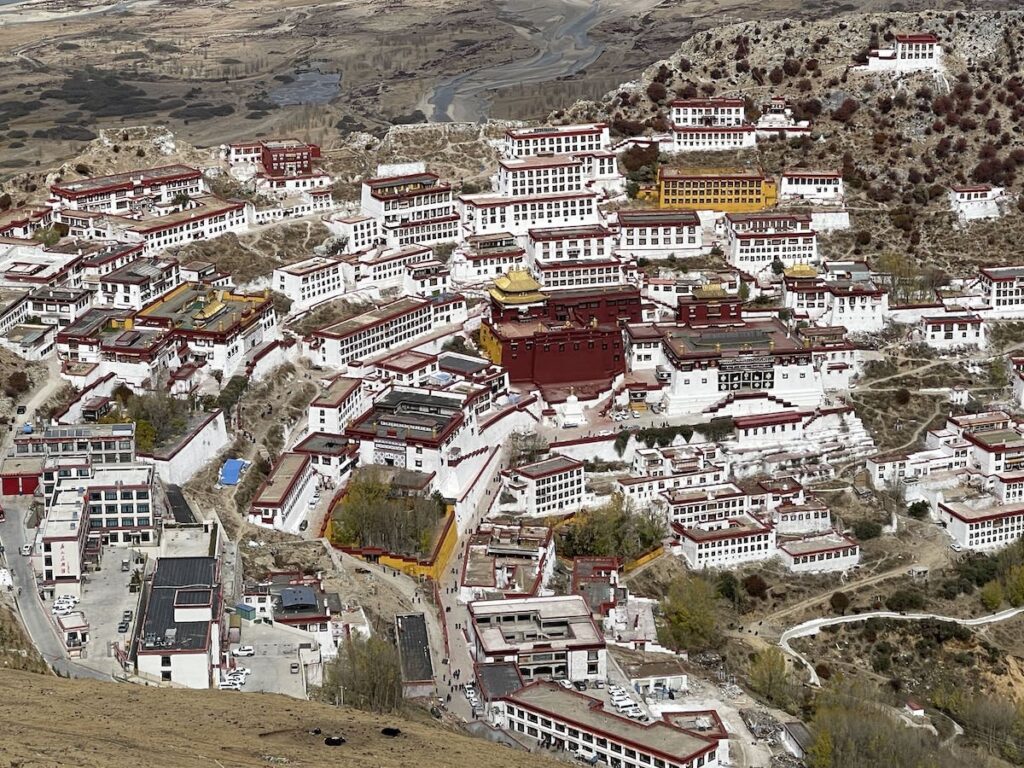
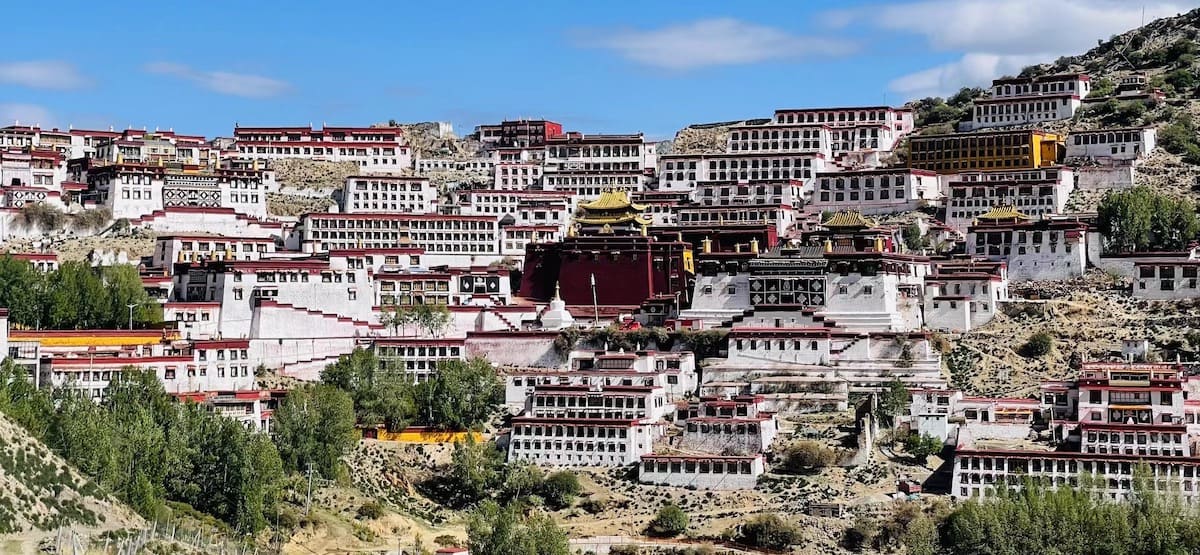
The architecture of Ganden Monastery reflects the grandeur and beauty of Tibetan Buddhist art and design. The monastery complex is built in a traditional Tibetan style, with a mix of intricate woodwork, ornate murals, and golden statues. Its structures are divided into several sections, each serving a specific religious or functional purpose.
At the heart of the monastery lies the Ganden Lhakhang (Main Temple), where a large statue of Je Tsongkhapa is enshrined. This temple is considered the spiritual center of the monastery. The hall is adorned with beautiful murals and thangka paintings that depict scenes from the life of Tsongkhapa, as well as various Buddhist deities and historical figures. The Ganden Lhakhang is not only a place of worship but also a repository of sacred Buddhist texts and relics.
One of the most iconic architectural features of Ganden Monastery is its position atop a hill. The monastery is built on Mount Ganden, which offers panoramic views of the surrounding valleys and mountains. The landscape itself plays a significant role in the monastery’s spiritual ambiance, creating a serene environment conducive to meditation and prayer. Pilgrims visiting Ganden often walk the Kora (pilgrimage circuit) around the monastery, a ritual that is believed to accumulate merit and purify the mind.
Beyond the main temple, there are various smaller shrines and chapels scattered throughout the monastery complex. These sites are dedicated to different Buddhist deities, and each has its own unique symbolism and significance in Tibetan Buddhist cosmology.
Despite facing challenges, particularly during the Chinese Cultural Revolution, Ganden Monastery remains a thriving center of Tibetan Buddhist practice. It has undergone extensive restoration in recent decades, with efforts to rebuild its structures and revive its monastic traditions.
The monastery is home to hundreds of monks who engage in daily rituals, prayer sessions, and meditation practices. The monks of Ganden study Buddhist philosophy, engage in religious debates, and participate in religious ceremonies. One of the most notable events held at the monastery is the annual Ganden Ngachoe festival, which celebrates the death anniversary of Je Tsongkhapa. During this time, the monastery is filled with prayers, rituals, and vibrant ceremonies, drawing both locals and international visitors.
Furthermore, Ganden continues to serve as a spiritual hub for the Gelug school, as it plays a crucial role in the education of young monks. Many prominent Buddhist scholars and teachers have emerged from Ganden Monastery, including some of the most respected Lamas and spiritual leaders in Tibet.
The aftermath of the Cultural Revolution left a lasting scar on Ganden Monastery. However, like other Tibetan monasteries. Restoration efforts began in the 1980s and 1990s, and today, much of the monastery has been rebuilt. Despite the challenges, Ganden has remained an important symbol of Tibetan culture and Buddhist identity.
A visit to Ganden Monastery is more than just a sightseeing experience; it is a spiritual pilgrimage that provides a deep insight into Tibetan Buddhist culture and philosophy. As one of Tibet’s most important monasteries, it offers an authentic experience of monastic life and an opportunity to connect with the Buddhist tradition profoundly.
Upon arriving at Ganden, visitors are struck by the monastery’s majestic setting. The drive to the monastery is filled with stunning views of the Tibetan Plateau, and as you approach, the monastery’s golden roofs, glinting in the sun, stand out against the backdrop of jagged peaks. The peaceful atmosphere of Ganden invites contemplation and reflection, making it an ideal place for meditation or quiet prayer.
While at Ganden, visitors can take part in the traditional Kora around the monastery. This sacred pilgrimage route is a powerful spiritual experience, where pilgrims circle the monastery, reciting mantras and offering prayers along the way. For many, the Kora symbolizes a journey towards enlightenment and a deepening of one’s spiritual practice.
Exploring the monastery itself, visitors can marvel at the intricate architecture, vibrant frescoes, and Buddhist artwork that decorate the temples. The central temple, with its revered statue of Je Tsongkhapa, is a focal point for visitors, many of whom take time to sit in silence and absorb the profound atmosphere.
Visitors to Ganden also have the opportunity to engage with the resident monks, who are often happy to share insights into their monastic lives and the teachings of Tibetan Buddhism. For those interested in deepening their understanding of Tibetan Buddhist philosophy, Ganden offers an immersive environment for learning and contemplation.
Ganden Monastery is not just a historical or architectural site, but a living symbol of the enduring spirit of Tibetan Buddhism. From its founding by Je Tsongkhapa to its present-day role as a center for Buddhist practice and scholarship, Ganden remains a cornerstone of Tibetan culture and religious life. It is a place where the profound teachings of the Buddha are upheld and practiced, where spiritual seekers from all over the world come to find peace and insight, and where the heritage of Tibetan Buddhism continues to thrive despite the challenges of the past.
Whether you are a devout Buddhist, a scholar, or simply a curious traveler, Ganden Monastery offers an unforgettable experience that connects you to the heart of Tibet’s spiritual legacy. Its beauty, serenity, and profound sense of tradition make it one of the most important and awe-inspiring monasteries in the Tibetan world.